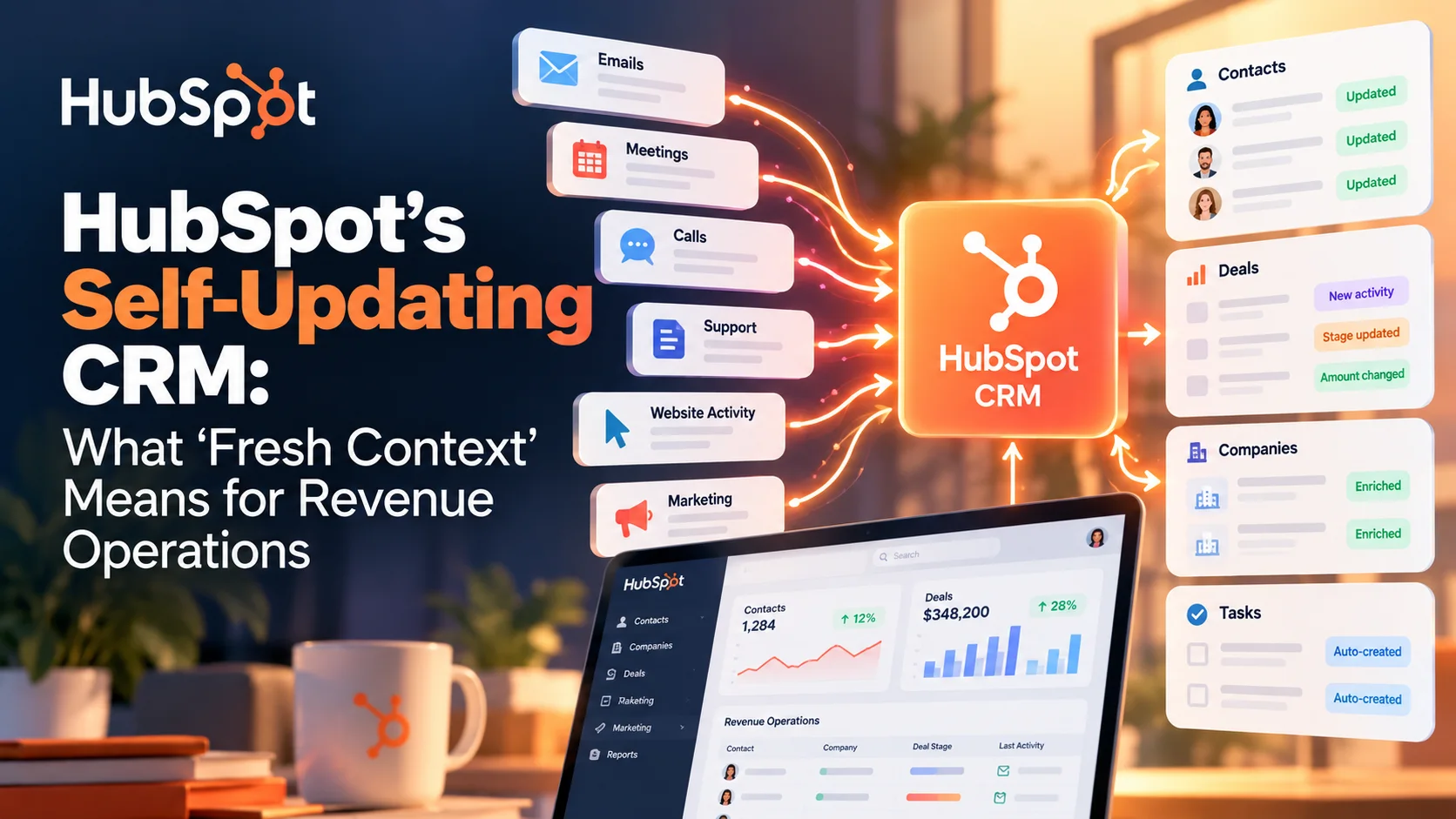
TL;DR: On September 16, 2026, HubSpot announced a deeper OpenAI partnership that includes an integration for customers to build, manage and measure ChatGPT Ads campaigns directly in HubSpot.
When campaign execution and CRM outcomes live closer together, teams can reduce some handoff friction—but only if campaign identifiers, contacts, lifecycle stages and revenue events are governed consistently. A native integration does not automatically solve attribution.
What changed?
On September 16, 2026, HubSpot announced a deeper OpenAI partnership that includes an integration for customers to build, manage and measure ChatGPT Ads campaigns directly in HubSpot.
Why this matters to revenue teams
When campaign execution and CRM outcomes live closer together, teams can reduce some handoff friction—but only if campaign identifiers, contacts, lifecycle stages and revenue events are governed consistently. A native integration does not automatically solve attribution.
Instead of treating a new sales or CRM capability as a feature-list item, ask which operating decision it changes: selecting a lead, prioritizing an account, preparing outreach, updating a record, routing work, or attributing a campaign. Each step has a different risk and control surface.
Map the current process first
Before enabling the feature, document the current path: where the signal originates, which system receives it, who owns the next action, what SLA applies, which fields change, and where human judgment is required. Without that baseline it is difficult to prove that a new tool improved the process.
What should be stored in the CRM?
- Source and source event
- Event timestamp
- Related person and account
- Confidence or verification state
- Action taken by an agent or human
- Outcome and override state
Define the automation boundary
Read, recommend, draft, enroll, send and CRM write-back are not the same permission. A new system does not need to automate the entire chain on day one. Start with lower-risk steps and increase authority only after measuring error rates and human override behavior.
Metrics worth watching
Do not measure activity volume alone. Track signal-to-action time, accepted recommendations, seller overrides, duplicate or incorrect assignments, reply quality, qualified opportunities and downstream pipeline outcomes. Otherwise it is easy to confuse more automated activity with better selling.
The biggest risk is bad context
AI and automation do not automatically repair incorrect CRM data. A wrong account owner, stale job title, duplicate contact or incorrect lifecycle stage can become a wrong action faster and more consistently. Measure freshness, completeness and conflict rates on the fields that drive automation before increasing autonomy.
Implementation checklist
- Define the use case in one sentence.
- Identify the required CRM fields.
- Separate what the agent may read from what it may write.
- Mark actions that require human review.
- Record baseline metrics.
- Test with a small user cohort.
- Review false positives and overrides.
- Do not increase autonomy until outcomes improve.
What the announcement does not mean
A vendor shipping a new AI or sales feature does not prove that conversion will automatically improve for every team. Vendor performance figures belong to their own customer population and methodology; your ICP, sales cycle, data quality and seller behavior can produce different results.
Sources and verification
Primary source: HubSpot — “HubSpot and OpenAI Deepen Partnership to Bring AI Transformation to Every SMB” (September 16, 2026). Recheck current availability, plan requirements, pricing, limits and rollout details in official documentation immediately before implementation.
Bottom line
When campaign execution and CRM outcomes live closer together, teams can reduce some handoff friction—but only if campaign identifiers, contacts, lifecycle stages and revenue events are governed consistently. A native integration does not automatically solve attribution. The useful question for a revenue team is not simply whether AI can sell; it is which sales decision can be automated, from which evidence, at what permission level, and under which measurement system.